AngularJS,Polymer,Vue,React:An Architectural analysis on fitment

Client side JavaScript is seeing rapid churn in last 3-4 years .There are many libraries and framework that are available . Some of them like angular try to span the complete framework space .Some of them like reactJs maintain their focus on single aspect of the rendering fragments . In the blog we will try to give a summary evaluation of how these libraries fit as an architectural  choice . We will refrain X versus Y feature between them as there are many posts available on internet on this.

While the MVC/MVC2 pattern has been around for decades there is marked difference when web frameworks try to adopt them. The traditional windows or mac OS native application frameworks had established couple of things clearly .

  1. Need to define clear models for application data
  2. Event lifecycle and catalog
  3. Orchestrations
  4. Resource handling

This is not a definitive and just summary of elaborate framework .Moreover its oversimplified but it helps us underline the fact that any SDK that tires to cater to MVC will evolve into similar fashion .

The web however imposes a new constrain on OS/Native framework which is the web. This includes the dual problem ie fetching resources from internet , typically over http and rendering them over browser .

Especially the browser as runtime for rendering and interaction poses 2 important problem .First being the laid out ,mostly document nature of the (hyper)text and media . Second being the impedance mismatch between the layout structure and the structure of data fetched from server. There were 3 clear movements in J2EE/JEE world over last decade  to solve this problem .

1. Introduce a near native runtime : This is the applet era where the code would travel from server to client browser and a JRE plugin will serve as additional runtime .The addon runtime provided the ability to give native OS like rendering and more programmatic control over data handling .As a philosophy this continued over rewritten JFX and to some extent Flash also .The key part being browser side stepping as runtime engine .
J2EE MVC By Libertyernie2 – Own work, CC BY-SA 3.0,

2. Pure server side rendering : The mainstream of JEE applications and also PHP/.Net but we will limit it to JEE due to my limited exposure to later. The flag bearer of this were/are servlet specification .This ie many version of servlet/filters and the other frameworks based on them like Spring MVC and Apaches Struts attempted to organize the MVC style fitment of components around the spec . The page however remained the Active-Java server pages . A phrase that is denote server side code execution that will  have better control over data lifecycle but will output markup on serverside. At times the pages could a curious mix of HTML/CSS/JS , java code ,and stringified HTML/CSS/JSS . The stringified code being the programmatic server side generation of markup that will then execute on browser (we skip other template engine here).

JSP tag library lifecycle © Apache.org

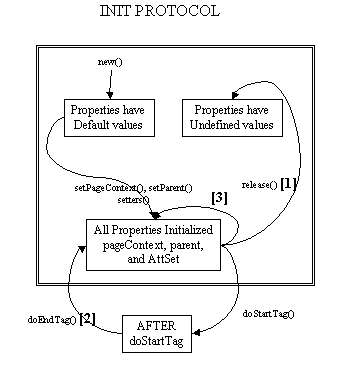
An attempt to systematize and eliminate this stringified  server code was done using tag libraries /JSTL. The taglibs introduced a component like boundary for markup and a lifecycle around code execution sothat the inter component and pure server side code can exchange data in defined manner .

3. Ajax driven semi server rendering : The sudden resurrection of AJAX resulted in more interactive application .Due to the ability of AJAX to facilitated isolated ie targeted rendering of fragment the server side page definitions become less and less relevant .A mix of only essential server side pages + pure HTML and direct access to services for data via AJAX resulted in more interactive jazzy web application .The fame of Gmail/Jquery/Dojo etc is this era .

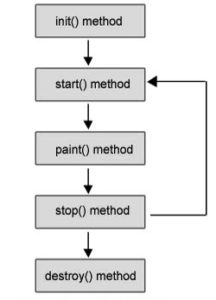
Portlet 2 spec ©JCP/Oracle

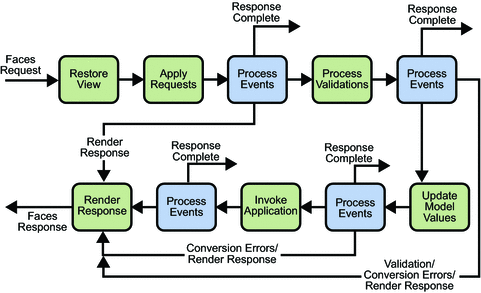
JSF LiifeCycle ©Oracle

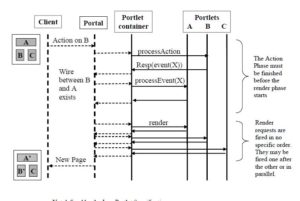
There was also an attempt in pure JEE space to provide server side framework that will have elaborate lifecycle which will represent both server and client side stages of rendering and control. JSF-Java Server Faces and portlet being the main ones .However it was awkward marriage to being with .This is due to mixture of event as phenomenon in linear execution model  where developer had to juggle lot much code handle events arising out of browser interactions.

It is then natural that the Ajax driven semi server controlled rending will morph into pure client side rendered applications. The likes of various jquery contributions libraries and backbone represent such transitions.

Due to the both the increasing power of browsers and the demanding UX requirements it was imperative that a pure client side or better called as browser native  (as opposed to OS native for VB) web frameworks evolve .Even the web standards specifications evolved rapidly giving support to this. When we talk or angular or React/Vue or Polymer web components we talk of this era.

While angular popularized the term SPA ie single page application and MVVM-a clone of MVC it is important to note that the design inspirations of such libraries are to how JEE stack frameworks evolved in early 2000s .

A typical webpage MVC framework will try to solve following problems

  1. Navigation, routing and subsequent data passing
  2. Rendering, events and Interactions
  3. State management, preliminary security and application organization

The first generation JS frameworks ie likes of Jquery ,Dojo,prototype solved the problem # 2 nicely  i.e. rendering ,events and interactions  .The attempt of a pure client side mvc application  mandated that Navigation and state also come under the purview of the framework .

Angular JS was the leading framework to provide the complete mvc style framework with elaborate sub frameworks for each layer ,sometimes adding its own complexity .  At the same the  even more evolving nature of UX , devices and browser support added following  forces to choice of framework .

  1. Focused rendering and state management at component level, sometimes reactive
  2. Collaborative components that can declaratively exchange data, on top of html spec
  3. Ability to delivery multi device and constrained device interactions (hybrid apps are taken for granted)

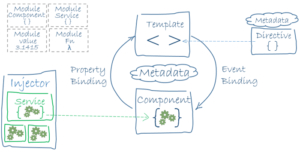
This resulted in almost all framework including angular ,vue ,reactjs and polymer adopt to a template driven component design with 1-2 way data binding . The components having an elaborate lifecycle to allow it to fetch data ,prepare markup and manage lifecycle transitions neatly . The component and lifecycle being commonality the following table describes these frameworks  as fitment for your architecture evaluation and choice .We are excluding aspects like test-ability , custom syntax and helper modules , isomorphic rendering  and packaging .We are assuming the vendor support ,community support ,developer enthusiasm etc are considered by most architects during open source framework evaluation .It must be also noted a contribution module can completely alter a given criteria so we stick to standard offering as a basis for our evaluation .

Angular4 Lifecycle via Angular.io

Area of responsibility Sub Area Angular

(mostly v4)

React Polymer

(mostly 1)

Vue
Navigation ,routing and subsequent data passing Model realization Component properties/metadata properties
App wide Menu navigation Routes ,Route components Component focused ,not available
Inter Fragment navigation Route/ routerLink Iron pages component
Navigational data exchange Route parameters,

Other contribution modules

Component focused hence data binding
Rendering , events and interaction Fragment definition Components , 1.5 onwards Web Components
Fragment lifecycle Yes .

OnInit-Ondestroy

DoCheck and After* methods

Yes .

Created-ready-attached-detached

Isolated  rendering Not in architecture Shady DOM
Templeted  rendering Component template assisted by directives Component template assisted by templateElements (as directives)
Cross fragment  Communication Data binding ,Event binding (two way) Data binding and listeners
State management, app initialization and application organization Cross fragment app level data/exchange Services Component focused so custom built
Convenience ·         Dependency Injection

·         Built in directives

·         Pipes

·         Behaviors

·         Custom elements

Styles External Custom CSS properties
Sponsor Google Facebook WebStandard/Google

A separate note mush to given about Polymer .In terms of its ability to address the componentized and templetized components that can be used to compose UI polymer relies on native browser support as opposed to vendor libraries . All the building blocks that webcomponets spec relies are part of w3c spec(true for both polymer v1 and v2). This eliminates the polyfills as the newer browser versions come . It also minimizes the angular 2 like major breaking changes or react like code mashup .

At the same time , given the component focus of this library ,one need to code the building blocks on page structure ,app shell and app wide idiosyncratic needs like central HTML storage or cross use case data passing.Much of these are available in polymers element catalog which gives a feel of application shell but they are still components contributed by Google outside the specification. So Polymer is best suited for application where componentization, isloation and reuse is more important. This is one area where React/Vue and their partner contribution modules that you will choose can score .  Angular 4 ,having acquired component nature with its elaborate  framework layers can cater to demanding application interactions and data lifecycle but this comes at the cost of complexity-maintainability and reuse .

The real question to ask when evaluating Polymer/RactJS/Vue versus angular 4 as architecture choice is how much fragment wiring by virtue of data binding will be good enough . Seasoned web developer who have experienced the event/callback hell as a design parallel  know the answer J .  If your requirements are sorted and support clean componentization then React/VUE or polymer is good enough fit . When modulerization and reuse are more important then Polymer scores over React /Vue . And when the requirements  guy  can be unpredictable Angular offers better choice between  design ideas and (complex)design arsenal …opinionated ie J

Edit : between the time this was written and now the industry has gained enough experience with this tool set.

This link https://www.matuzo.at/blog/2023/single-page-applications-criticism/ and this https://infrequently.org/2023/02/the-market-for-lemons/ and the sub references in these posts have thought that i would have posted today .Anyone following my page can benefit from reading these 2 .

The case against chatbots

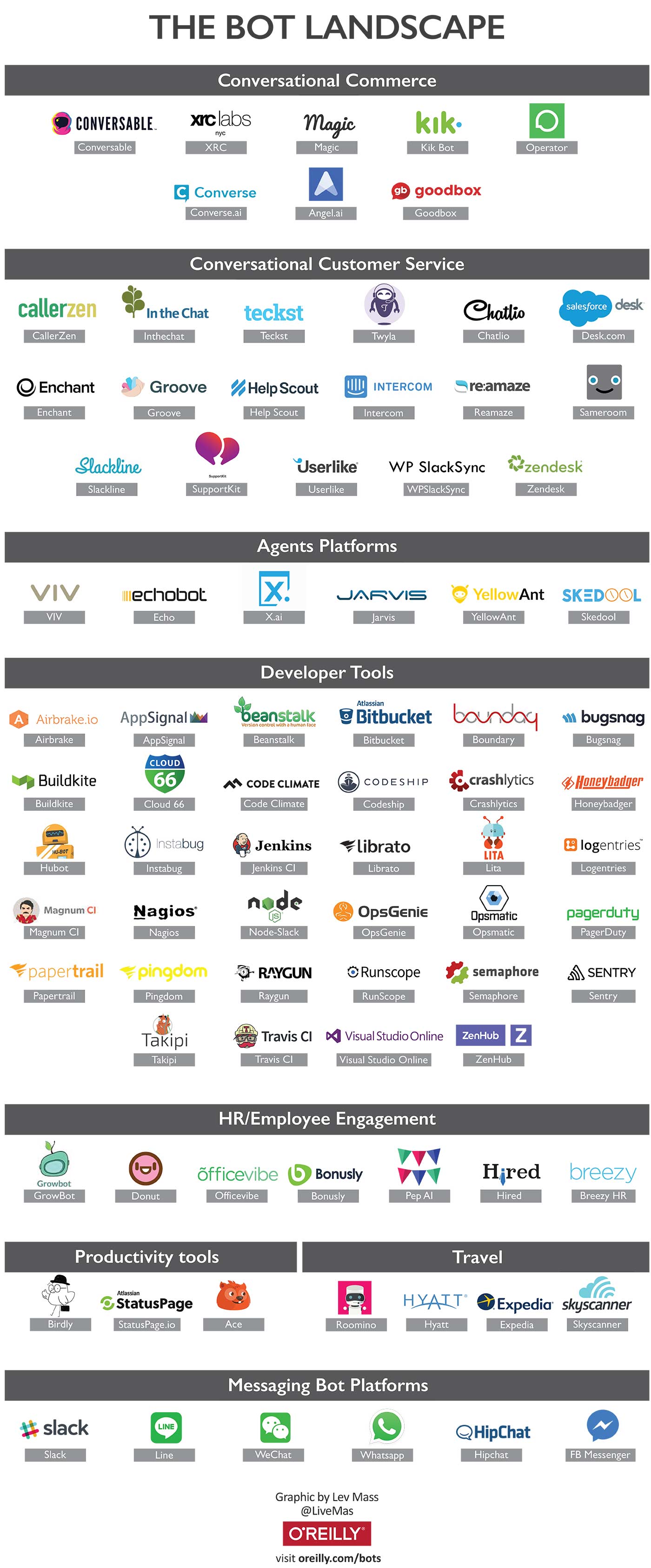
So , 2016 was year of chatbots . See the graphic at the end (its big image )and we see so many of the mainstream companies having built their bots . A github repo search will reveal similar story.The buzz that chatbots are creating is huge .So much so that people are claiming that chatbots will kill websites and mobile apps soon .We even notice that similar buzz was created a decade ago when mobile apps and app stores became mainstream .The mobile app wave was also looked at but incredulity so it is natural to be more welcoming towards chatbots wave .But the similarity does not hold beyond the English sentence you just read.

The move from website to mobile was actually reshaping of the form factor of the computing device .It is but natural ,albeit in hindsight ,that the content and its delivery fits itself into the new form.In the mobile wave also , the mobile and the app , were used interchangeably .While the mobile represents the shift , the app merely represents engagement .This difference is vital to analyzing the chatbot buzz .

Matt Schlicht,of the Chatbot Magazine defines,“A chatbot is a service powered by rules that a user interacts with using a chat interface. The service can be any number of things, ranging from form to function and live in any major chat product” . One might agree with this definition as is or diff with it in parts .While chatting itself is not a new paradigm nor is the concept of a daemon processing accomplishing the task , it is the combination of a always running agent , the bot facilitating the chat.The daemon could assigning your chat requests to human beings ,in a typical support center scenario .It might be reading your sentences and applying some pattern rules to serve reconfigured response .And because the state of the commoditized art allows us to program interpret ,human sentences (either typed or spoken), the so called NLP engine can be plugged into the chat bot to enhance the precision to the intent inference .

Most of the NLP styled chatbot guides mention NLP and intent-action mapping in the same breath ,but this is false connection .Intent-action mapping is what it is ,whether the inference is made via NLP,regex or rulesets. One might also throw machine learning in the stack to further enhance the inference via correlation and other techniques .Well that’s the short summary of what we get to read in the chat bot buzz as the first thing. What goes missing many times is the true nature of the chatbot for the end user , i.e. the conversational quality .

It is this conversational quality of the interaction , that needs deeper scrutiny ,because it represents an alternative to the laid out quality of our interfaces .

Its fine to say that Language is the most natural interface humans understand, and that’s the interface that bots use.but to miss that human language has an intent-explain-infer-confirm cycle embedded into it .

This model is very powerful the “range” of the expression is huge , like asking for a qualified advice amidst multiple factors .But it is very lengthy when the expressions are straight forward .

A typical chatbot sample told to us will be either a flightbooking bot, a billpay bot or an e-commerce bot.All these interactions are well modeled to human mind and the laidout-selection model fits better there .Infact it is an liberal model (read open) for both the parties to explore more options alongside the intended interaction.
Where as a personal assistant that can suggest a song based on the whether condition,travel duration,earlier playlist usage and so on , is the right case for chat (voice or test of gesture) to digest the complexity of intent-explain-infer-confirm cycle .
Thus the argument that because the end user are moving and are more and more available on chat platform and hence the business process should also move to them will add to chat fatigue once the novelty fades out .
We need to trust the end use to be able to decide on more convenient and time efficient model of interaction and offer them.Hence the conversational quality , used at qualified places while retaining the laid-out quality of presented content is the right blend .A jump into chat via bot will be shortlived for most mainstream businesses .Infact the power of ML or AI ,as we like,implies that the business understand and serve (ready to serve) us better even before we start interacting .To transport this whole responsibility onto AI assisted chat interfaces via chatbots is laziness .
In the end , there is a Google search experience to rescue.It lays out a nice search box for us to express , then does huge work in the background to make best sense of what we intended yet subtly suggest us alternatives and corrections ,like human conversation,if the confidence in the inference it made wasn’t high .
It is good case of fitment driven software than buzz driven software ..and that’s the case against chatbot , AI or no AI.

Here are some samples of how subtly google lays out the conversations , courtesy: littlebigdetails .
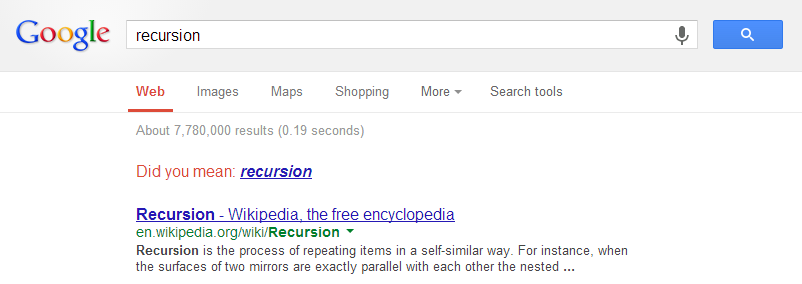
1. If you search the word “recursion” in Google, it’ll suggest “recursion”. If you click on the suggestion, it’ll suggest “recursion” again… creating a recursive search.And don’t miss the spell correction prompt “did you mean”

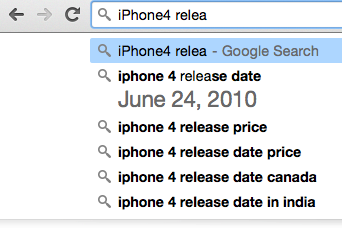
2.Google Chrome – Displays some search results in the suggested input area

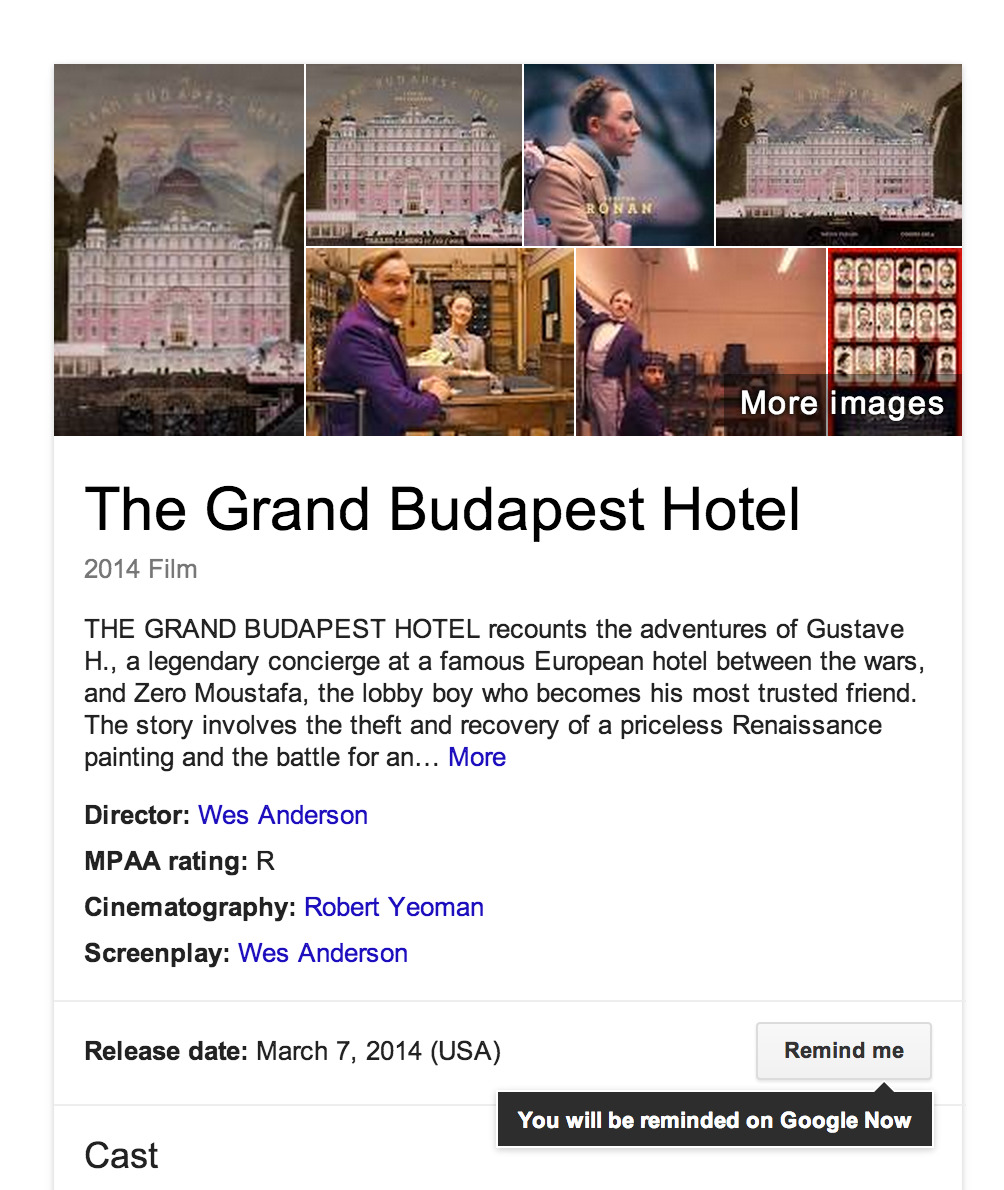
3.When searching for an upcoming movie, the Knowledge Graph box shows the release date and asks if you’d like to create a reminder.

4.The Oreily report :

Bot Landscape,Oreily

Digital transformation don’t get confused

So every organization and their sales guy is pitching you about the wave of digital transformation that is essential to your organization and to be ready for the future. It is a must a do for cxo and their architects, if their business has to stay agile and thus, relevant.

Quite true, isn’t it? There is indeed a great sense is taking all your process online, enhancing your digital presence, offer deeper engagement to your end users and grow your business, except that under the noise of these right sentences, lies a misuse, overuse and confusion of the underlying terms which, if true, can lead to different path than intended.

Earlier attempts

The fact that businesses need to go online, i.e. be present on the same electronic plane that their customers exist and then offer interactions on the electronic plane is something that we all came to realize with the dot com era. A business should rightfully move in sync with their customers likings. This used to be called, for a long time , e-everything. E as in electronic. We had e-commerce-payments, e-medicine and so on, overlapping with its twin buzz words, web as in website and online as in online store. What this wave started was indeed a digital view of the world except that for the most part, it was a conversion of existing paper based on a human-facilitated way of doing business. Of course it had resulted in gains by sheer virtue of the expansion of reach it produced.

Digital transformation wave on the contrast is about expansion of the depth . The depth to which end-user can interact with a business and everything around it. Along with this, businesses must also look into essential services like the top Internal audit services if they truly want their brands to be efficient.

Genesis of digital transformation

Human mind is a double edged sword. At one end it can offer rich contextual insights about everything that ,computers are still struggling to match. At other end it can create huge roadblocks due to the linearity with which it sees the world. Imagine a loan application, while you are filling up the forms, can one parallelly start estimating your loan worth?, can it eliminate your need to sign at multiple places or your need to photo copy and attach supporting documents. We need to also consider that the process of application is designed with average human being in mind, on both sides of the interaction, mind you; so we introduced, a sequentially to the process.

It is this human intervention both apparent as well as embedded that the digital transformation wave intends to eliminate. Eliminate so that ,the depth to which the end-user can interact with business is enhanced by order of magnitude. It is apt to call this process as digitization. Digitization of all human intervention, obvious as well as implicit so that the interaction process is as below

Charetiristics of useful digital transformation

1.Instant :Instant as in immediate .Because we eliminate the human aspect of service ,we also eliminate queue nature of our business interaction.This is not same as number of simultaneous users but the ability of the system to react immediately and lead the user to the next logical step or even fulfilment of the process itself.

2.Always on:Always on is not the traditional availability,which is a service indicator that is essential to digital business .But if say ,your payment is waiting for payment network to be on or your application is waiting for an approver and appraiser to process it is not Always on.

3.Resumable : Tought we enable to business process to always on and instant , the same constraint does not apply to the end user .This calls for a resumability of the business process at a later point . Resumability is not a mere memory of users unfinished actions but also updating those actions for the business context that might have changed in the (larger) time lapse that might have occurred .

4. Simplified :As we digitize the actors and process in our system ,it also allows us to eliminate many constrains thus allowing us to simplify the whole user experience in our process . However simplification is not a call for giving up prudence ,but to shift it to a later phase or in background so that the regular flow in the system is far more short, easy and clear. This might even call for coordination between diff systems for this . A case in point is use of precomputed credit score to allow on demand consumer loan. Stay competitive by offering affordable processing credit card fees to your customers.

5.Parallelized : Removal of human view of the business opens up many opportunities to parallelize the tasks in the process so as to shorten as well as smoothen the overall journey .

6.Inferential: As we digitize diff aspects of our business , we also enable addresability of all these entities .This allows us to infer lots of data points,decision making,exception in our system to everyones benifit .An easy example is use of QR code or face recognition or even user segment to accelerate overall process .

Whereas,simplified is often misquoted as frictionless and Inferential is often mis-understood as big data analytics.

It is also important to stress that the earlier attempt of e-fication has sometime resulted in partial achievement of above goals.But due to generational nature of transformation waves,it often merely converted existing process in electronic forms.Case in point,tough e-payments was established early on,it took long time to allow e-cheques inside the system. Where as the main aim of digitization should have been ti eliminate the need of cheques as means of payment as well as legal record.

What then becomes obvious is that digital transformation will need lots of effort to question the business practices , to re imagine the world in digitized manner, and then do it ie digitally transform.For which,most often, that CMS platform,MbaaS suite,service gateway and so on,is not a pre condition.It might ,at max be, an eventual fitment.

Good luck

Future of channel banking apps post amazon go

Amazon go store

In consumer space.. is bleak.Amazon just launched an Amazon go service  .


The idea is to walk around the store picking items and let the amazon magic wand do the billing and payment for you. Something like how magic bands worked in amusement part.What is important here is not how amazon will identify the chosen products but how it will bill the customer.The experience amazon wishes to give via go service is that of on tap shopping.This mandates that the act of billing your account will be on tap.We can draw an anology with how oauth made user authentication ontap for content providers.This is huge.

The idea of some sort of token of your payment power was well established by cheques and later via plastic cards. The point of sale handled the other part of giving identity of the billing party. The same was replicated by e-commerce sites. However whats was missing here is a marriage of discoverability of both the parties as well as payment completion on the same tap.And all withing the realm of regular banking. We can alternatively say that the ease propagated by maverick fintech of dot com era as well as current breed of startup is going mainstream. All via the power of amazon to shape and coerce new behavior.

The problem that consumer banking apps went on to solve were that of products, payment’s and problems. Its is at the payment level most of the problems and innovations in this area happened. What amazon go will propagate is the paradigm of account as a service ,on which payments can be made. Its kind of stretching the event horizon. Because once the cognitive habits of tap and pay becomes normal,all the problems of discovery and identification become part of a universal,standardized infrastructure that most bank will end up supporting. The shift is so fundamental that the current attempts of standardization of bill payment,QR cheques,universal account identifiers and the payment networks will be forced to coverage and fall in line with account ad service model due to sheer power of end user convenience.

What then is left with banks is products and problems. The products being the universal facility that banks offer and where information technology has little to offer apart from some trivial suggestion based on consumer profile.And the problem part which the support executive can’t get rid of, so much the banks would love to eliminate and are nowadays looking towards bots as hope.

We must also factor in the usual suspects of value chain arguments. In a world where bank account and transfers are available as standardized commodity,there will be an inclination to move up the value chain,but we must remember the very reason of the channel banking app was to outsource clerical load onto consumer and let them do it.What more can then be more up the chain than liberalize payments and accounts further and let the bank focus where their strength lies ie better banking products. So skip the temptations to bring some workflow,fund sharing- social features to your banking apps.The consumers might not,all,need it ;and in the light of account as services the app ecosystem will take care of the latest , mostly transient tides of consumer behavior.

Teacher and Guru

Got this  in an email ..dunno the author … read the last line its awesome ..

==============================

TEACHER & GURU

A teacher takes responsibility of your growth
A Guru makes you responsible for your growth

A teacher gives you things you do not have and require
A Guru takes away things you have and do not require

A teacher answers your questions
A Guru questions your answers

A teacher helps you get out of the maze
A Guru destroys the maze

A teacher requires obedience and discipline from the pupil
A Guru requires trust and humility from the pupil

A teacher clothes you and prepares you for the outer journey
A Guru strips you naked and prepares you for the inner journey

A teacher is a guide on the path
A Guru is a pointer to the way

A teacher sends you on the road to success
A Guru sends you on the road to freedom

A teacher explains the world and its nature to you
A Guru explains yourself and your nature to you

A teacher makes you understand how to move about in the world
A Guru shows you where you stand in relation to the world

A teacher gives you knowledge and boosts your ego
A Guru takes away your knowledge and punctures your ego

A teacher instructs you
A Guru constructs you

A teacher sharpens your mind
A Guru opens your mind

A teacher shows you the way to prosperity
A Guru shows the way to serenity

A teacher reaches your mind
A Guru touches your soul

A teacher gives you knowledge
A Guru makes you wise

A teacher gives you maturity
A Guru returns you to innocence

A teacher instructs you on how to solve problems
A Guru shows you how to resolve issues

A teacher is a systematic thinker
A Guru is a lateral thinker

A teacher will punish you with a stick
A Guru will punish you with compassion

A teacher is to pupil what a father is to son
A Guru is to pupil what mother is to her child

One can always find a teacher
But a Guru has to find and accept you

A teacher leads you by the hand
A Guru leads you by example

When a teacher finishes with you,
you graduate
When a Guru finishes with you,
you celebrate

When the course is over you are thankful to the teacher
When the discourse is over you are grateful to the Guru
~~~~~~~~~~~~~~~~~~~~~~~~~~~~~~~~~~~~
Good Luck

National Skill Registry : Profiling IT professionals

Lets get it straight guyz .

Would you like keep an account of your romantic encounters online ?
The one which contains list of people you had relations with . The one which can be tomorrow be upgraded so that it contains details of exactly what kind of relations you had with them .The one with which people can ask you questions like “did u have sex and how many times?” . The one which you may be forced to reveal when you plan to get married ?

IF you are a girl you will immediately get my point .

National Skills Registry [ https://nationalskillsregistry.com/ ] is an initiative by nasscom running for quite a long time .It aims at keeping a database of all the IT professionals .Its a permanent account maintained by an IT professional. These details will be upgraded as the employee moves across companies . The same data will be used for background verification and routine stuff you would see about profile maintenance on orkut or facebook . They even claim of 4 lakh successful registration !Gosh what happened to IT professional .

I find this quite suspicious and dangerous plan which aims at tightening controls over personal rights of IT professional .The fact that this is a permanent account sounds too dangerous to me , like the romances example I gave at the outset .

Lets c how , The first and foremost reason that Nasscom gives is that of security .
It says that since Indian IT industry is booming and since India doesn’t have an electronic registeiry of its citizen ,so its a concern with our clients when it comes to background check .

Question is which Background ?

Now there can be no doubts on IT clients seeking assurances about the people that they outsource to . If in case Nasscom is getting inspiration from US social secutiry system then its a fair thing to pursue . Nobody , including me , will want criminals at workplace .We should have a way to handle this .But that’s about it .
The rest that is said in support of this registry sounds like some smart marketing to me .

First and foremost ,security assurances to its clients is about the social record of the person .There is no reason to include his employments details and so on in this .

Secondly If at all such assurances is needed then Nasscom , with its technical and monetary strength should convince Govt of India to establish a social net than do it herself . Infcat such a registry should be maintained for everyone in India . Being a criminal be it CEO of a company or the office peon is euqally harmful to IT ecosystem .

And this is where Nasscom fails to establish its intigriyt .We can say that an association of IT companies so its targeting only IT professional .

No my friends this is too short and too sweet of a justification for this . Nassmcom first of all is association of IT companies . It is not organization of IT professional .Its the masters club ,however much we pretend .I leave rest to your thinking here 🙂 .

The next point is , by definition this is Skills registry . It aims to cover all historical data of an employee . Which all companies he worked for ? which all skills he worked on . The duration .
The salaries … wel I personally haven’t registered for this .But lets use common sense.

Even if intimate details like salary aren’t captured in this registry How much time do you think it will take . The day this registry becomes a hit , it will become a norm .And that day my frined it will not take much time for companies to force one to update his salary there .

Nassmcom does say that the data in this registry is controlled by the professional .Wel it must be but there is a good word that we use in IT industry .. “As of Now ” . Yes as of now it is .Tomorrow there can be a regulations 2.0 where in it will be mandated to keep one appraisal details in it . It can be extended to gather details to any minutes details like the years spend onsite foreign countries and so on .

Do you think companies will be hesitant to put salary and such details of their employees in such a database ?
Go and ask if you have any friend in recruitment process . Or if you have faced a job interview and bargained for things you would get sense of where I am coming from 🙂

you have no Idea , If I were an employer , how delighted I would be to have such a minute data about people i hired or will hire . Its would be a dream situation of having complete control over IT employees who any way aren’t allowed to form Support Groups .

And in essence this registry by its design can be very dangerous to IT folks . This or any attempt of profiling common people is to be suspected for its intention . The last such experience that history tells us is soviet russia and the KGB net that is said to have noted down minutest details .Again i leave rest to your own thinking .

Now lets look at the fundamental point that arise out of this issue .
That of Individuals freedom and Job Background verification .

Job background verification seems to be the prime intention that evident from NSR .
Now this is a real issue and this has nothing to do with security :).
This is quite an individual matter of what honesty an individual chooses to practice .Compare this to tax filing and you would be clear on the risk and honesty aspects of it .

As much keeping false claims in ones resume is a real concern, so is this being a pure business scenario . Its about how companies can and should verify Job Background and the business rather monetary aspects related to this . I for once and all I like such business issues be handled by market itself than NSR like profiling .

IT and most of the service Industries are about brands . A company and its trustworthiness as well as that of people working in it is purely determined by its brand . This is real market differentiators . We should be using the same as a base fro Job profiling . Rather this is how Indian IT industry seems to be working now . And again this is the final and real determinant factor .

NSR or no NSR ……
such brand establishment by an company by its corporate and Skills related practices . Or say by the employees by getting professional certifications or working in such companies should be the direction which Nasscom is working in .

NASSMCOM should have created industry wide system of skill certifications on diff Job profiles . It could have mandated , like we do in stock markets , Annual Job certificates by IT companies to employees .There could be more such open and fair ideas that could be cited .

Any falsification after that would be an individual risk .And so long people can pull such lies off or they get caught he has right to do so. For once such events strengthen the system than weaken it.It puts the strength of the system under scanner and makes them responsible for it .This is how nature and civil society works . Sadly this philosophical clarity is missing in NSR .

The point is in the onus of establishing ones rightful credential should be on the entity who wishes to benefit from it and they way they wish to benefit from it . Any overseeing body if at all regulatory should see that there are enough credential establishment events available so that such brands can be built and people benefit from the brand . After all there is a market for unbranded stuff too and thats a market reality too !

Beyond that NSR by its name and design it an attempt ar profiling people , having complete control over it . Its like treating IT professions like suspects, the only difference is this time its worded differently …and its web enabled..and its on name of security …and its from NASSCOM !

PS : Being an IT professional I am not making any conclusion on what an individual should do with NSR lest it goes against the conduct expected by my employer . I have taken care to keep this strictly as a critique and at a though argument level . I wish no political or monitory benefit from this blog entry.
EveryOne is expected to make his own decisions and the thinking needed for it . I wish not to dictate it 🙂 _Sachin .